[GMC Main]
[6066 GMC Club]
[What’s New]
[Engines]
[Support]
[Memorabilia]
[GMC Gallery]
[GMC ID]
[VIN Numbers]
[Contact]
[
Discussion Group]
[Lighting & Electrical]
[V6 Performance]
May 1960 Motor Life

Road Testing The New V-6 Engine
Written by Barney Navarro
Amid the announcement excitement of this 1960 car season, one major development
sneaked onto the scene with relatively little fanfare. A V-6 engine has been a topic
of speculation for years; now GM has one. Granted, the new powerplant can be found
at this time only in a pickup truck, but such a unit certainly has possibilities for
future passenger car power. With this in mind, Motor Life’s Technical Editor
has produced this first complete test and analysis of the new V-6 by General Motors.
The Strongest impression that stems from driving the V-6 is the feeling that something
of the past has been recaptured and blended to a machine of the future. From the past
comes the ability of the engine to operate at a very low rpm, it will pull the vehicle
as slowly in high gear as was commonplace 30 or more years ago. looking into the future,
it’s an entirely new engine that will be around for a long while because of the
unprecedented effort to develop a mechanism with a long life.
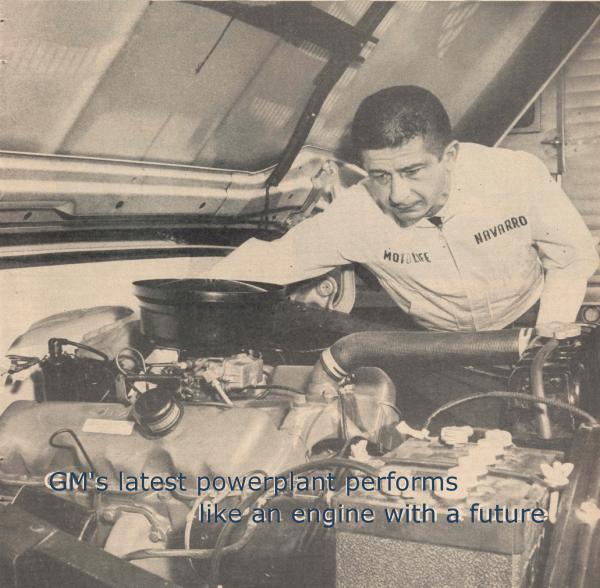
Until the hood is lifted and the spark plug wires counted there are no clues to indicate the
a six cylinder engine is propelling the vehicle. Operation is so smooth that it is hard
to believe that the engine isn’t a V-8. Actually, certain phases of its operation display
a greater freedom from vibration than is normally experienced with a V-8 powerplant.
The sound of individual exhaust pulses at low speeds even has the tendency to create the
illusion of a V-8 with numerically small rear end gear ratio. However, the discriminating
ear of the expert will observe a greater regularity in the off-beats lacking is the
characteristic confusion of sound that we have become so used to.
Since the V-6 fires alternately from bank to bank (it never fires consecutively in one bank
anyplace in the firing order), its exhaust pulses closely resemble those of an opposed engine.
The only off-beat generated is the result of two banks emptying into one common exhaust pipe,
which makes the flow path of the left bank slightly longer than the right.
Economy resulting from a long life span isn’t the only way that V-6 owners will save. Gas bills
should also be low, as the test figure of 13.7 miles per gallon indicates. A look at the factors
involved in racking up this fuel consumption figure make it even more impressive.
A total vehicle weight of 4040 lbs. coupled with a 3.92-to-1 rear end gear ratio isn’t a combination
that normally spells good gas mileage. Neither is the 7.75-to-1 compression ratio thought of a being
high enough by today’s standards to provide economical operation. Despite the first impression created
by these statistics, the economy experienced in the road test indicates that there is something happening
that bears explaining. A study of the engine is really necessary to fully appreciate its
seemingly unusual behavior.
Low speed full throttle depression presents the most startling characteristic in the performance of
the V-6. Instead of the normally expected bucking that results from poor low rpm fuel distribution
or the complete fade out of power observed with large carburetors, acceleration takes place in the
same manner as with a more conventional engine turning twice the rpm. The only indication of low
engine speed is the slow measured pulsing of the exhaust.
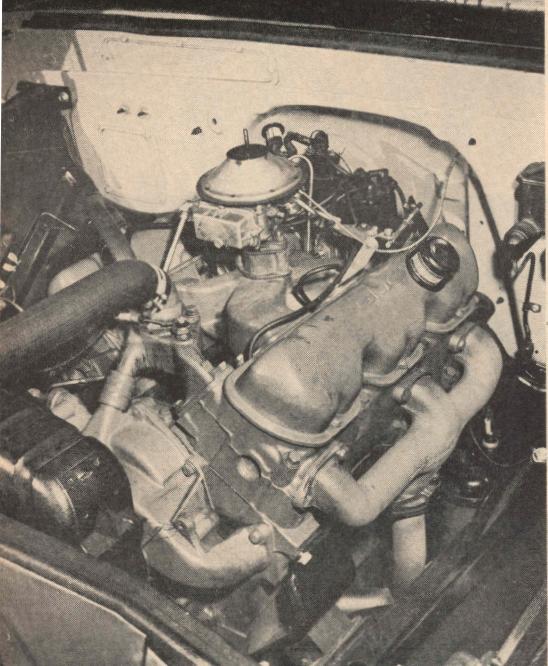
Though Narrow due to the 60 degree Vee, engine has appearance of
massiveness; displacement, however, is only 305-cubic-inches.
High Torque is obtained in part by single throat carburetor.
Many features contribute to the V-6’s outstanding low rpm performance, some of them are peculiar
to the engine itself and others are the result of falling back on old practices almost forgotten
by the majority in this era of high speed engines. Short valve duration and small venturi area
probably have more to do with exceptional lugging ability than anything else that can be done to
an engine. The GMC 305-A model that was tested employed a small single throat Holley carburetor
quite similar to a type used on an economy inline Six. The small venturi area of this carburetor
makes it possible to maintain high carburetion velocities even at low rpm.
Now that the engine’s performance relationship to conventional practices has been touched upon,
it is necessary to view the advantages unique to V-6 cylinder arrangement. As is the case with
any V-type engine, the path that the fuel mixture takes after leaving the carburetor is dependent
on many design features, characteristics that add up to a number of coincidences peculiar to the
V-6. Actually the mixture course had ad its foundation the configuration of the crankshaft.
The acute angle of the cylinder banks naturally places the intake ports of one bank more closely
to those of the other than if the angle was 90 degrees like the V-8. The shorter span reduces the
length of the intake manifold passages considerably. Three intake ports positioned uniquely in
each head, coupled with the peculiar firing order of the engine, makes it possible to feed all
six ports from one single throat carburetor without encountering inequality in flow path length.
Each head has its intake ports spaced so that one opening is isolated at one end, whereas the
other two are adjacent.
Since right and left bank heads are identical so as to be interchangeable, the paired ports
appear at opposite ends of the engine. The adjacent intake ports of the right bank appear at
the rear and the corresponding ports of the left bank are at the front. This layout makes it
possible to place the carburetor at the center of the engine without creating a more direct
flow path for each of the center cylinders. Direct paths are to be avoided in manifold design
unless all cylinders receive equal treatment. Equal fuel mixture delivery is the ultimate aim
and one that is well realized in the V-6 design. Again we find concrete reasons for its low speed
lugging ability which is so good that high gear starts can be
accomplished with judicious use of the clutch.
When Appraising the performance of the V-6 one must bear in mind that basic theme followed by
design engineers was one that placed low rpm performance uppermost on the list of required
features. Its 150 hp output at 1600 rpm in not an outstanding rating for a 350 cubic inch
engine but the torque figure of 260 lbs-feet at 1600 to 2000 rpm is exceptional. In keeping
with the declared theme, high horsepower output wasn’t to be sought after if high rpm was
necessary to attain it since low speed operation lengthens the life span of the engine
to such a great degree.
A firm forward thrust at low speeds when the throttle is floored inspires a belief that
acceleration will be fantastic. This is a mistake brought about by the association of high
performance with large displacement passenger car engines. Actual acceleration tests gave a
0-to-60 time of 15.1 seconds, which is below par for a 305 cubic inch engine propelling
a 4,000 lb vehicle.
Even though the GMC V-6 is designed for outstanding low rpm performance and a 100,000 to
200,000 mile life span, a high rpm version could be built for passenger car use. More
carburetion and longer valve opening duration could raise the output of the engine considerably.
Though this possibility exits for an engine using the V6 configuration, none of the GMC’s
that range in displacement from 305, 351 to 401 cubic inches will ever be used. The narrowness
of 60 degree cylinder banks would make them very practical for placement between front wheels
but the excessive weight of all components makes current models impractical.
A portion of the high weight of parts is attributable to the long life aim that is so apparent
in the design of the engine. However, part of it can be blamed on the crankshaft requirements
of a V-6. Instead of being able to pair the cylinders with throws, like the practice in V-8’s
when four throws serve eight cylinders, six individual throws are required. The end result is
a more complex crankshaft than in used in V-8’s and one that is considerably heavier due to both
the increased odd positions of throws. These factors plus extra “Beefing” for longevity add up
to a 110 lb. crankshaft for the 401 Cubic inch model. A V-8 engine of comparable displacement
would have a crankshaft weighting approximately 63 lbs.
Working upward from the crankshaft it will be observed that everything about the design of the
engine demonstrates extra sturdy construction. The Crank rotates in four large main bearing
saddles supported by a deep skirted crankcase which extends well below the bearing centerline.
Connecting rods are short and sturdy and the attached four ring pistons employ top ring land
inserts to reduce ring land wear. the inserts are made of steel and are cast
integrally with the piston.
When viewing the crankshaft, it again becomes apparent that a coincidence is utilized to make
a better engine of the V-6. The sharp 60 degree angle makes it impractical to place the cam in
the crankcase over the crankshaft as is common practice in V-8’s, so it is located in a valley
between the cylinder backs. By so placing the shaft, the bottom of the valley can be utilized as
an oil trough to insure lubrication to the lobes and lifters before the engine is even started.
A secondary bonus feature of this layout is the reduction in push rod length made possible. Short
push rods are naturally stiffer than long ones and they weight less so valve float is prevented
without resorting to excessively heavy spring tension.
Father up the valve train we find a novel utilization of aluminum in the rocker arm brackets.
Although the use of aluminum for this purpose in not new, recognition of an unexpected benefit
is fresh. The high expansion rate of the aluminum brackets is depended upon to lift the rocker
shafts a distance corresponding to the expansion of the valve stems after the engine gets warm.
This calve-stem-expansion compensation trick prevents radical Changes in the valve lash
so the engine sounds the same cold or hot.
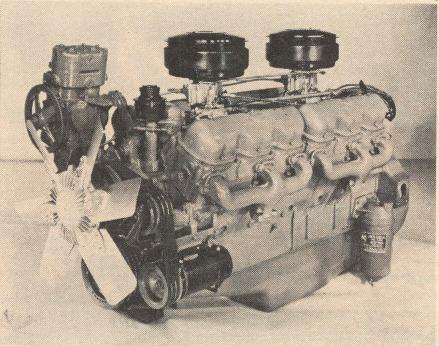
After examining the V6 in its entirety, the question naturally arises, was the engine conceived just
to make a narrower powerplant? Again we find that the true story is due to an interrelationship,
and simplification of age old problems. The desire to have a 702 cubic-inch V12 probably had
something to do with the V6. What simpler way could the family be extended than to make the
majority of the parts from the 351 cubic-inch V6 interchangeable with the V12. Basically all
that is needed to build a V12 is a different block and crank and a double dos of V6 parts.
So Many parts are interchangeable between all of the V6’s and V12 that production costs
and parts inventory costs have been cut to the bone without any sacrifice in Utility.
|
TEST DATA |
Return to The 6066 GMC Trucks Memorabilia Page.
~
6066 GMC Trucks ~ 6066 GMC Trucks ~
6066 GMC Trucks ~ 6066 GMC Trucks ~
6066 GMC Trucks ~ 6066 GMC Trucks ~
6066 GMC Trucks ~ 6066 GMC Trucks ~


© WebPage Design, 2000-2006 6066 GMC Trucks.
© Artical & Photos, 1960 Motor Life.
Last Updated January 1, 2006.